
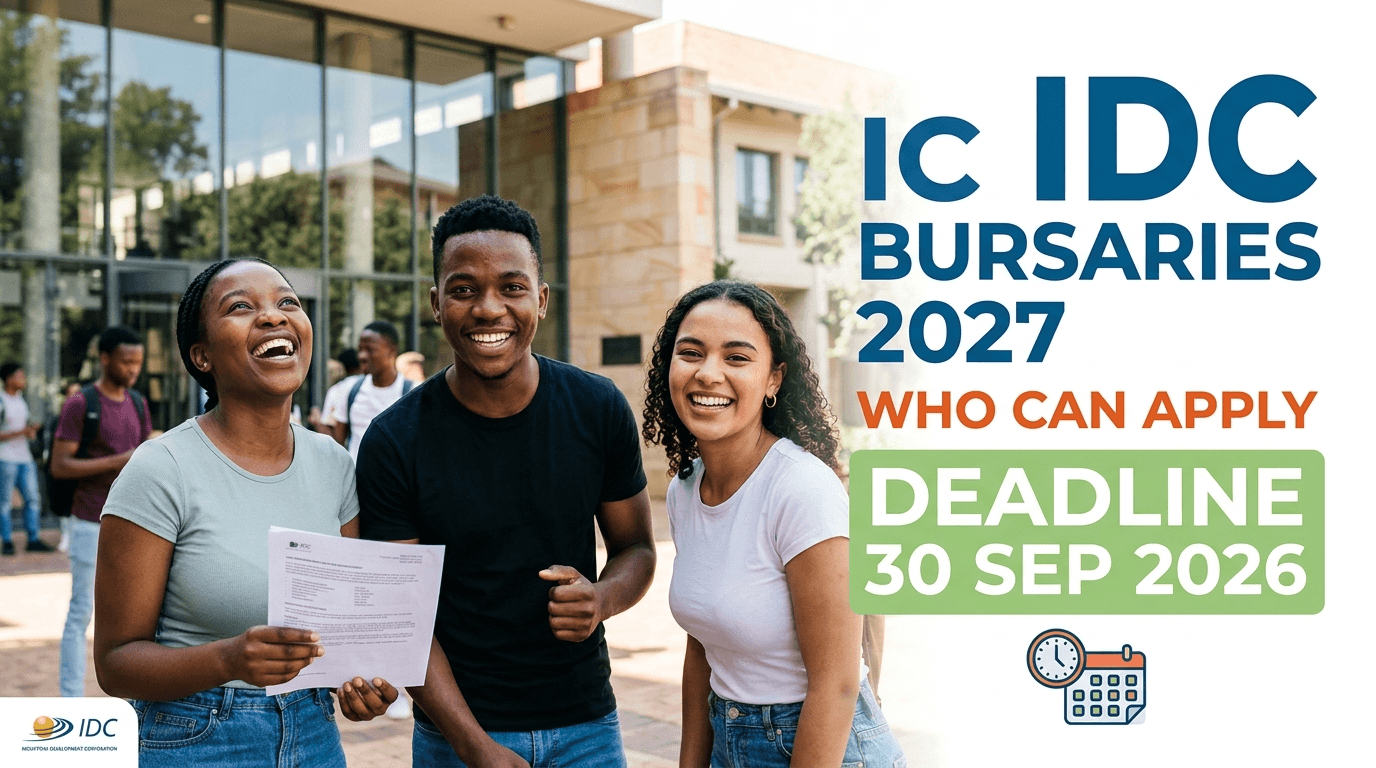

IDC Bursaries 2027 are about to close, and the deadline is 30 September 2026. If you need help paying for university next year, this is a chance to study without shouldering the full cost.
What the opportunity is
The Industrial Development Corporation (IDC) launched its External Bursary Scheme on 1 June 2026. It can pay tuition, on‑campus or approved off‑campus accommodation, a meal allowance, transport costs, a one‑off laptop and other approved study expenses.
Who can apply
- South African citizen
- 26 years old or younger
- Unemployed
- Financial need – household income ≤ R350 000 per year (applications from households earning R350 000–R600 000 are considered after an affordability assessment)
- Planning to study full‑time at a public university or university of technology
- Applying for a first undergraduate qualification, unless applying for an approved Honours programme
- Meet the academic requirements of the chosen qualification
- Provide all required supporting documents
What you can gain
Successful applicants may receive a package that covers the following, depending on the bursary agreement:
- Full tuition fees
- University accommodation or approved off‑campus housing
- One‑off laptop
- Meal allowance
- Transport allowance
- Other approved study‑related costs
Fields of study that are funded
Finance and business
- Accounting (Chartered Accountancy pathway)
- Financial Management
- Internal Auditing
- Cost & Management Accounting
- Investment Management
- Risk Management
- Transport Management
- Logistics Management
- Supply Chain Management
- Entrepreneurship
- Finance, Economics, Econometrics
- Business Management, Financial Accounting, Financial Engineering
Engineering and built‑environment
- Industrial, Chemical, Electrical, Electronic, Mechanical, Mechatronic, Mining, Civil, Construction‑related Engineering
- Quantity Surveying, Metallurgical Engineering
Science and technology
- Analytical Chemistry, Geology, Actuarial Science, Data Science, Environmental Science, Quantitative Risk Management, Physics
- Bachelor of Science programmes, Biotechnology, Agricultural Studies, Mathematics, Statistics, Computer Science, Information Science, IT, BCom in Information Systems
Law and education (specific qualifications only)
- BCom in Law (Commercial Law), LLB, Diploma in Law Studies
- Education programmes listed on the IDC approved list
How to apply – step‑by‑step
- Visit the official IDC online bursary portal and register a new profile.
- Fill in every mandatory personal and academic field.
- Enter accurate household‑income details.
- Select the exact qualification that appears on the IDC approved list.
- Upload all required supporting documents (certified ID, proof of residence, academic results, admission letter, income proof, etc.).
- Complete the online interview questionnaire.
- Review every answer and every uploaded file for clarity.
- Submit the application before 30 September 2026.
- Save the confirmation email or screenshot as proof of submission.
Tips to improve your chances
- Aim for at least 75 % in your Matric results (or 65 % average for current tertiary students).
- Maintain a minimum GPA of 60 % while funded.
- Preferably come from Quintile 1‑3 schools, rural or previously disadvantaged communities, or have a disability – these factors are looked at favourably.
- Ensure every certified document is dated within the last three months, clearly visible, and includes the commissioner’s stamp.
- Gather income records early – payslips, bank statements, SASSA letters, or affidavits – because they can take time to obtain.
- Create a single, clearly named digital folder for each required document and double‑check the files before uploading.
Insider tip: Do not wait until September to collect income records and certified copies. Start now, organise them in separate folders, and review each file before you begin the online form.
Final thoughts
IDC Bursaries 2027 can remove a large part of the financial barrier for students entering high‑need fields such as engineering, finance, science, IT, law and education. Eligibility hinges on age, citizenship, income, academic performance and the first‑qualification rule. Collect your documents early, confirm your exact qualification is on the approved list, and submit your application well before the 30 September 2026 deadline.