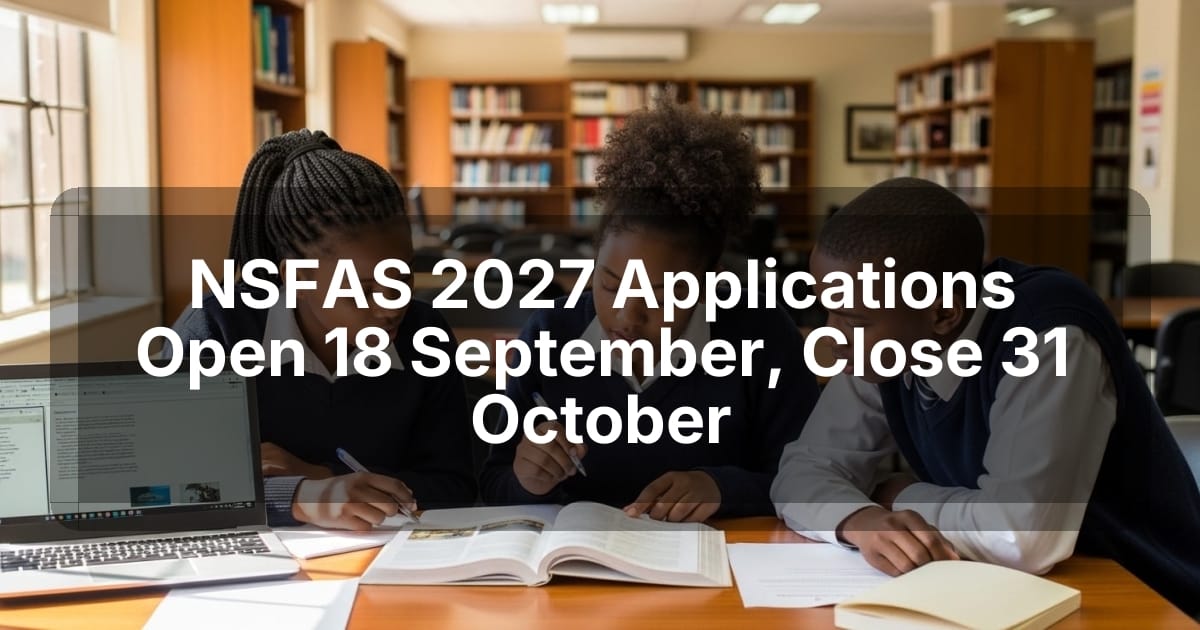

If you plan to study at a university or TVET college in 2027, you can start preparing your NSFAS application now. The National Student Financial Aid Scheme has published the 2027 application window. Funding applications open on 18 September 2026 and close on 31 October 2026. After that date, NSFAS says late applications cannot be accepted.
Many students worry they will miss the window or use an old date from a screenshot. That fear is fair. Application dates change from year to year, so the dates below come from official NSFAS application information, not from a Facebook post or WhatsApp message.
What the NSFAS 2027 application is
NSFAS is the National Student Financial Aid Scheme. It provides financial aid to eligible students at public universities and TVET colleges in South Africa.
The 2027 funding application is free. You submit it online through the official myNSFAS platform. Admission to a college or university does not automatically mean you will receive funding. You still need to apply correctly, and NSFAS still needs to assess your application against the funding rules.
The official NSFAS website currently lists these details:
- Applications open: 18 September 2026
- Applications close: 31 October 2026
- Application fee: Free
- Application platform: myNSFAS
- Funding year: 2027
The window is fixed. Prepare your information before the final week so a missing document or a login problem does not push you past the closing date.
Dates can change between intakes. For the 2026 academic year, NSFAS previously reported that applications opened on 16 September 2025 and closed on 15 November 2025. The 2027 window is different: 18 September to 31 October 2026. Do not rely on old posts or screenshots. Check the current NSFAS website when you are ready to apply, because dates and requirements can be updated.
Who can apply
NSFAS’s current information says eligible applicants include South African citizens and permanent residents who plan to study, or who are already registered, at a public university or TVET college. Eligibility also depends on the funding rules that apply to you and on your circumstances.
Funding and academic registration are related, but they are separate processes. You should complete the NSFAS application and also follow the admission and registration steps of your chosen institution.
Not every student who applies will be funded. Competition depends on the rules and on whether your information and documents meet what NSFAS asks for. A complete application does not guarantee an offer.
What NSFAS funding can cover
NSFAS explains that support can differ by institution, qualification and living circumstances. Official information lists support such as:
- Tuition and registration
- Accommodation or transport
- Learning materials
- Personal care allowances for qualifying students
There is no single amount that every student receives. Be careful with social-media posts that claim every NSFAS student will get a set monthly stipend in 2027. Current official application information does not set one universal monthly amount for every 2027 applicant. Funding depends on factors including the institution, the qualification and where you stay.
How to apply
Use the official NSFAS website and myNSFAS portal, not links sent through unofficial pages. You can start at the official NSFAS website and submit through the official myNSFAS portal. The platform currently lists 18 September 2026 as the opening date and 31 October 2026 as the closing date.
Step 1: Create or open your myNSFAS profile. Register with your correct personal information. If you already have an account, sign in and continue.
Step 2: Complete the application. Give the personal and household information that the form asks for. Check your names, identification details and contact information before you move on.
Step 3: Upload the documents that your profile requests. NSFAS may ask for supporting documents depending on your circumstances. Upload clear copies so the information can be read.
Documents or forms that may apply include:
- A completed NSFAS consent form
- Declaration documentation where applicable
- Disability-related documentation if you have a disability
- Orphan or vulnerable child documentation where applicable
- Other supporting documents requested for your circumstances
NSFAS also lists examples such as a retrenchment letter, death certificate, divorce decree, proof of legal guardianship or marriage certificate where these apply. You will not need every document on this list. Follow only the request shown on your myNSFAS profile. Do not upload unrelated paperwork.
Step 4: Review everything, then submit. Saving your details is not the same as submitting. Follow the platform instructions and confirm that the application has been submitted.
Step 5: Keep your application reference number. Check your myNSFAS account often for updates or requests for more information. NSFAS advises you to keep your cellphone number and email address updated so you can receive important messages.
There is no application fee. If someone asks you for money to submit the form, or promises to speed up funding, do not pay them. Never share your password or one-time PIN. Use only the official NSFAS and myNSFAS platforms.
Tips before you submit
Many applicants struggle with small errors that slow the process down. Check these points before you click submit:
- The application is for the 2027 academic year.
- Your personal information is correct.
- Your cellphone number and email address are current.
- Your household information is accurate.
- Required documents are readable.
- Any consent or declaration forms are completed correctly.
- The application has actually been submitted.
- You have saved the reference number.
- You will keep checking your myNSFAS account for updates.
Give truthful details. Apply early enough to fix a missing document or a wrong contact number before 31 October 2026. Do not wait for the last week if you can avoid it.
What to do next
You have a clear window: applications open on 18 September 2026 and close on 31 October 2026. Use that time to gather the documents your profile may ask for, create or open your myNSFAS account, and submit only when the details are correct.
After you submit, keep your reference number and check the account for messages. NSFAS can update dates, document rules and funding information, so confirm the important points on the official platform before you make a decision. A careful application gives you a fair chance to be assessed. It does not promise funding, but it keeps you in the process.