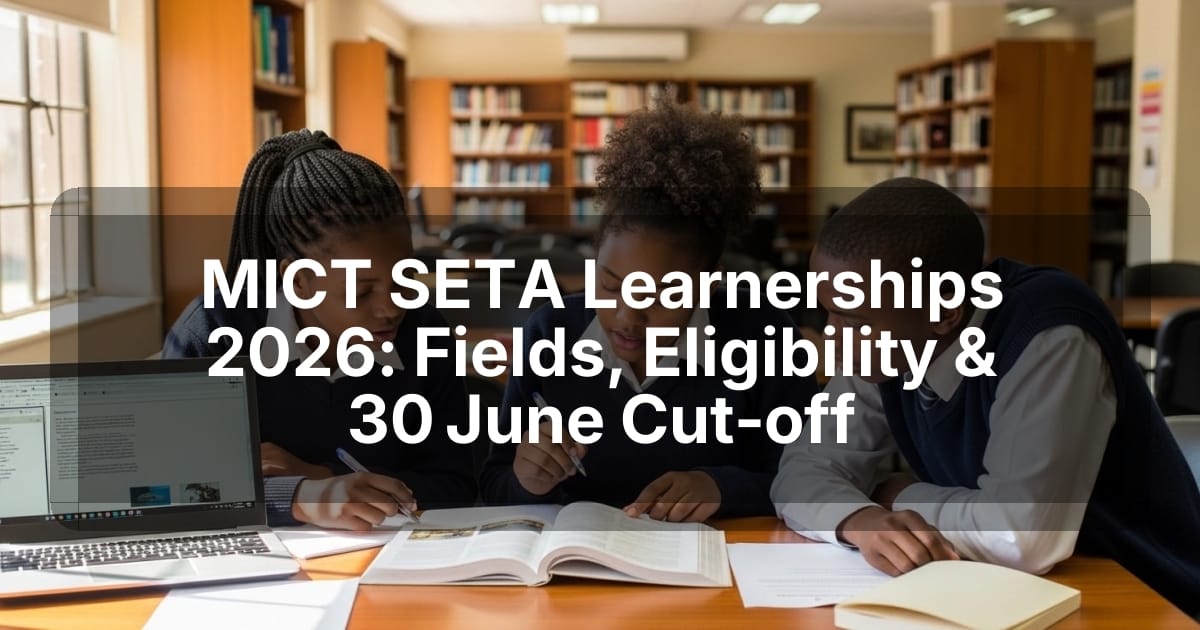

Right now, South Africa needs more skilled workers in technology, media, and communications. MICT SETA offers learnerships that combine classroom learning with on‑the‑job experience, giving you a fast track into these fast‑growing sectors.
What the opportunity is
MICT SETA (Media, Information and Communication Technologies Sector Education and Training Authority) funds learnerships and occupational learning programmes across five main areas:
- Information technology
- Telecommunications
- Electronics
- Advertising
- Film and electronic media
Each programme leads to a recognised qualification, but there is no single “MICT SETA Learnership 2026” with one application form or deadline. Employers or training providers run the individual intakes.
Who can apply
Eligibility varies by programme. Some learnerships accept Grade 12 learners, others require a diploma, specific subjects, or work experience. Common requirements include:
- Grade 12 or equivalent
- Mathematics or Mathematical Literacy
- English language proficiency
- Relevant IT or media subjects
- South African citizenship
- Unemployment status (for certain pathways)
- Age limits or provincial residency (where specified)
- Disability criteria for targeted programmes
Always read the exact requirements for the specific intake you are interested in.
What you gain
Successful learners receive:
- A nationally recognised NQF qualification (level depends on the programme)
- Paid workplace experience – most learnerships include a monthly stipend (amount varies)
- Practical skills that match industry needs, such as software development, testing, hardware support, digital advertising, or media production
- Better job prospects in the ICT, telecoms, electronics, advertising, and media sectors
How to apply – step by step
- Identify a current intake. Look for announcements from an employer or accredited training provider.
- Confirm the exact qualification title and its SAQA identification number.
- Check that the qualification is still open for new enrolment (many older qualifications closed on 30 June 2026).
- Review the minimum education, age, and residency criteria.
- Prepare the required documents (see next section).
- Register on the official MICT SETA Learner Management System: https://lms.mict.org.za/accounts/register/. This creates your profile but does not submit an application.
- Follow the specific application instructions provided by the recruiting employer or training provider (upload your CV, ID, certificates, etc.).
- Submit before the deadline stated in the announcement.
- After submission, keep copies of all correspondence and watch for confirmation of acceptance.
Tips to improve your chances
- Use the exact qualification name and NQF level in your CV and cover letter – recruiters look for a match.
- Highlight any relevant coursework, projects, or part‑time work in IT, media, or advertising.
- If you are applying for a new occupational qualification (e.g., Software Engineer NQF 6, Advertiser NQF 5), mention any software tools, design programmes, or communication experience you have.
- Provide a clear proof of residency and a copy of your South African ID.
- For older qualification listings (e.g., Systems Development NQF 4), ask the provider whether it is a new intake or an outdated posting.
- Be honest about your status; many programmes give preference to unemployed South Africans.
- Submit a well‑formatted, error‑free CV – recruiters often receive many applications.
Typical documents you may need
- Updated curriculum vitae
- South African identity document (ID) or passport
- Grade 12 certificate or proof of equivalent qualification
- Academic transcripts or tertiary certificates (if required)
- Proof of residence (utility bill or lease agreement)
- Disability documentation (only if the programme targets disabled learners)
Only provide the documents listed in the specific advertisement.
Important 2026 qualification change
On 30 June 2026 the final enrolment date for 32 older MICT qualifications passed. These include programmes such as End User Computing, Systems Support, PC Engineering, Business Analysis, Graphic Web Design, Film & Television Production Operations, and several advertising qualifications.
Learners already enrolled before that date may still complete their studies, but new applicants cannot join those programmes now. Instead, look for the newer occupational qualifications that MICT SETA has registered, such as:
- Software Engineer – NQF 6
- Software Tester – NQF 5
- Computer Technician – NQF 5
- ICT Business Development Consultant – NQF 5
- Advertiser – NQF 5
- Sound Operator – NQF 5
- Media/Programme Content Production Manager – NQF 6
These newer pathways replace many of the older titles and are the ones you should target in 2026.
Choosing the right field for you
- Software and coding: Look for the Software Engineer or related development programmes.
- Software quality: Apply for Software Tester learnerships.
- Hardware and support: Computer Technician positions suit those who enjoy troubleshooting.
- Tech sales & business: ICT Business Development roles combine technical knowledge with client interaction.
- Advertising: Advertiser programmes focus on creative campaigns and brand communication.
- Sound and media production: Sound Operator or Content Production Manager learnerships are ideal for film, TV, and broadcasting interests.
Match the qualification level, stipend, and location with your personal goals before you apply.
Closing dates
There is no single general closing date for all MICT SETA learnerships. Each employer or training provider sets its own deadline, so always follow the date listed in the specific advert.
Final thoughts
MICT SETA learnerships can launch your career in South Africa’s digital and media industries, but success depends on finding the right, currently open intake, meeting the exact qualification requirements, and following the recruiter’s instructions precisely. Check the qualification, the recruiting organisation, and the application deadline before you submit anything.