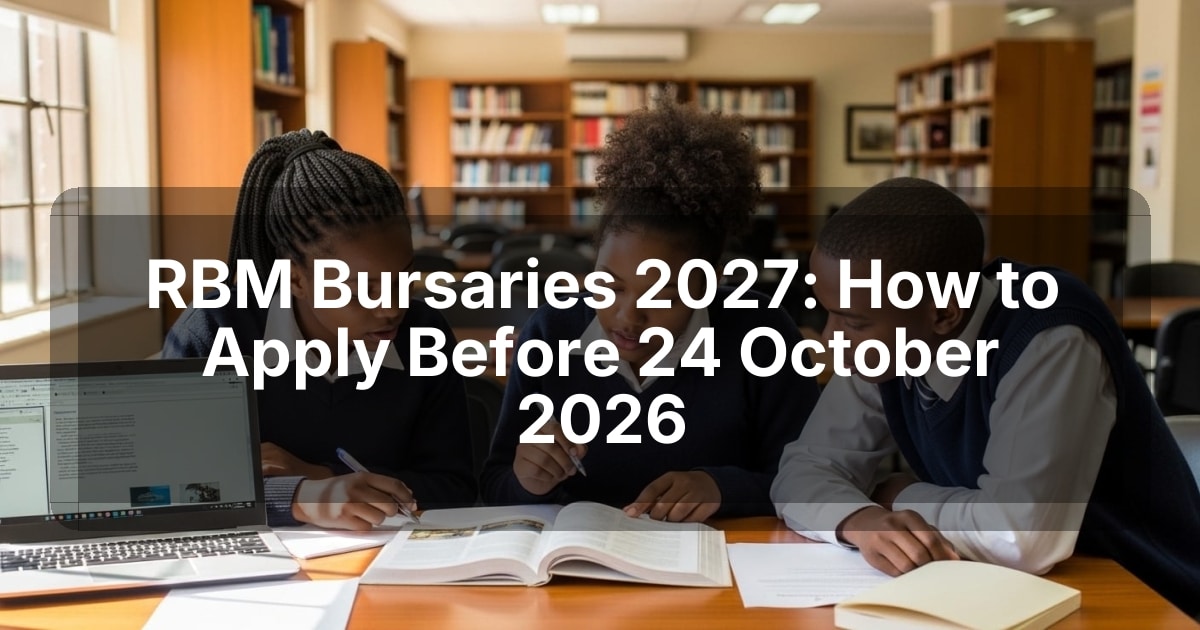

If you are finishing Grade 12 in 2026 and need help paying for university, the Richards Bay Minerals bursary for 2027 is open right now. The closing date is 24 October 2026. That gives you a clear window to prepare your documents and apply properly.
What is this bursary?
Rio Tinto’s Richards Bay Minerals (RBM) offers this bursary to South African learners who will start their first year at university in 2027. It supports both technical fields, like engineering, and non-technical fields, like law, health sciences and media.
RBM’s core business is mineral sands mining and refining in Richards Bay. But the company also funds studies that serve the wider community, from nursing to journalism.
There are two separate listings:
- Core disciplines (R66691) — engineering and science fields linked to RBM’s mining work.
- Non-core disciplines (R66689) — fields such as health, law, finance and communication.
You must apply under the listing that matches your exact course. Many applicants get this step wrong, so check carefully.
Who can apply?
You qualify if you meet all of these:
- You are a South African citizen.
- You are completing Grade 12 in 2026.
- You have an average year mark of at least 65%.
- You qualify for financial assistance.
- You plan to study a supported field at a recognised, accredited South African university.
Please note: this intake is only for learners still in school. If you are already studying at a university, contact recruitment first to ask whether another route applies to you.
Many applicants believe 65% alone secures a bursary. It does not. Financial need, complete documents and the selection process all matter. Competition is strong, so treat each requirement seriously. RBM also gives priority to suitably qualified people from designated groups, including women and persons with disabilities, where they are under-represented. The academic and document rules still apply.
Which route fits your course?
Use the exact course name, not the faculty name. Engineering subjects appear in both listings, so the broad label is not enough.
Core disciplines (R66691)
- BSc or BEng: Extractive Metallurgy, Electrical Engineering, Mechanical Engineering.
- BSc: Environmental Science, Geology.
Non-core disciplines (R66689)
- Engineering: Civil Engineering, Land Surveying, Industrial Engineering.
- Sciences: Computer Science, Data Science.
- Social Sciences: Community Development, Criminology, Psychology.
- Humanities: Journalism, Media, Communication.
- Health Sciences: Pharmacy, Nursing, Medicine.
- Management Sciences: Economics, Commerce, Finance.
- Law and Safety: Law, Safety Management.
Here is an example. Industrial Engineering is an engineering course, but it falls under the non-core listing. Compare the qualification on your acceptance letter with the correct group before you continue. Nursing students also apply under the non-core listing (R66689), as long as they meet the Matric, academic, financial and document requirements.
What do you gain?
The bursary helps you start your first year in 2027 without carrying the full cost alone. It also connects you to a company that invests in skills across technical and non-technical fields.
Be honest with yourself here: the official listings do not list the exact funding package. Do not budget for tuition, accommodation or allowances until you receive a written offer. Confirm the covered costs, limits, renewal conditions and any obligations in that offer before you plan.
Which documents do you need?
Check these eight items before you upload anything:
- A comprehensive CV.
- Your certified South African ID copy, not older than three months.
- Your certified 2026 Grade 12 midyear report.
- Proof of provisional university acceptance.
- Your certified parent or guardian ID copy.
- Parent or guardian income proof or a payslip.
- A motivation explaining your chosen field.
- Certified proof of your residence or home address.
Make sure your name, study field and contact details match across all documents. Use the university’s official acceptance letter, not an acknowledgement of submission. Ask your university about your application status early. Check that every scanned page is clear and readable.
If your household has no payslips, contact recruitment before you submit. Ask what proof they accept for unemployment, pension or grant income, and for your residence address. Explain your situation so you can prepare the right evidence in time.
How do you apply?
- Match your course to the correct group above and note the reference: R66691 for core, R66689 for non-core.
- Open the official listing on Rio Tinto’s careers platform: the RBM 2027 Core Disciplines listing or the RBM 2027 Non-Core Disciplines listing.
- Follow the prompts and complete your personal, education and study details accurately.
- Upload all required documents. Review certification dates, file completeness and the qualification on your acceptance letter.
- Finish your submission by 24 October 2026 and keep any confirmation or reference number you receive.
For programme questions, email [email protected]. Include the reference (R66691 or R66689) and describe your exact question about a document or course.
Tips to improve your chances
- Write a real motivation. Link your course to a genuine interest, school project or responsibility. Explain what you learned and why you want to study it, using examples you can support.
- Certify correctly. Your ID copy must be certified and not older than three months. Old certifications cause rejections.
- Get proof of acceptance early. Contact your university about your decision now. Ask recruitment what evidence they accept if your letter is delayed.
- Apply under the right listing. A course that does not match the listing may not be considered.
- Do not wait for the deadline. Upload early so you have time to fix any problems on the portal.
What happens after you apply?
Selection starts shortly after the closing date. If you receive no feedback after about 30 days, the guidance is to treat your application as unsuccessful. Do not let that discourage you from applying to other opportunities while you wait.
Take your next step
Choose the correct route for your course, secure your university acceptance proof, and check all eight document groups. Submit online before 24 October 2026 and keep your confirmation safe.
You can also compare more bursaries on SETA Careers as you plan your university funding. Every careful application you submit today builds your chances for 2027.